• Guest - w'd love to know what you think about the forum! Take the 2025 Survey »

Dr Malcolm Kendrick on statin side-effects. All in the mind?

I guess you haven't read his fence sitting are the way through?

https://drmalcolmkendrick.org/2016/04/25/what-causes-heart-disease-part-xii/
What every body needs is a propensity for blood to clot. No one wants to die from cutting themselves all alone, and bleeding out. Similarly, there needs to be a process which prevents overclotting. It's called balance.
Did you miss this ? Or simply ignore it ?
"So, ahem yes, blood borne lipoproteins do have a role to play in CVD. The role is not key, but it is there. I thought I should get that off my chest."
and why 'not key' ?
"The reality is that virtually every substance that can be found in the blood has some influence on blood clotting – and there are an enormous number of substances in the blood."

Left wondering what I was meant to take from your link
Geoff
 
What every body needs is a propensity for blood to clot. No one wants to die from cutting themselves all alone, and bleeding out. Similarly, there needs to be a process which prevents overclotting. It's called balance.
Did you miss this ? Or simply ignore it ?
"So, ahem yes, blood borne lipoproteins do have a role to play in CVD. The role is not key, but it is there. I thought I should get that off my chest."
and why 'not key' ?
"The reality is that virtually every substance that can be found in the blood has some influence on blood clotting – and there are an enormous number of substances in the blood."

Left wondering what I was meant to take from your link
Geoff

Yes, I agree it's a very nondescript (as usual) page.
Very hard to infer anything fro the link, as you say.
 
"All you need to do is to look at the lines going down to the right and wonder how on earth we ever got away with telling people that cholesterol causes heart disease. High cholesterol is associated with lower heart disease and vice versa – for all the data available in the world. High cholesterol is not even associated with high heart disease, let alone does it cause it."
http://www.zoeharcombe.com/2010/11/...is-a-relationship-but-its-not-what-you-think/
God bless ststisticians.
Geoff

upload_2017-5-9_6-47-46.png
upload_2017-5-9_6-48-41.png
 
News reports today that statins could help with MS. Are they losing money because so many people will not take them now?
I have become a great skeptic now.
 
"All you need to do is to look at the lines going down to the right and wonder how on earth we ever got away with telling people that cholesterol causes heart disease. High cholesterol is associated with lower heart disease and vice versa – for all the data available in the world. High cholesterol is not even associated with high heart disease, let alone does it cause it."
http://www.zoeharcombe.com/2010/11/...is-a-relationship-but-its-not-what-you-think/
God bless ststisticians.
Geoff

View attachment 22885
View attachment 22886


Indeed, Zoe has a good line on statistics.
r =0.13 again, I wonder if anyone could draw a different line that fitted the data with more than a 13% chance of being correct?
Maybe she'll publish the raw data plot one day, and let us have try to draw a more representative line?
 
Indeed, Zoe has a good line on statistics.
r =0.13 again, I wonder if anyone could draw a different line that fitted the data with more than a 13% chance of being correct?
Maybe she'll publish the raw data plot one day, and let us have try to draw a more representative line?
You seem to be using the r value like a blunt instrument, the very thing you warned people using BG as.
"While 'r' (correlation coefficient) is a powerful tool, it has to be handled with care.

  1. The most used correlation coefficients only measure linear relationship. It is therefore perfectly possible that while there is strong non linear relationship between the variables, r is close to 0 or even 0. In such a case, a scatter diagram can roughly indicate the existence or otherwise of a non linear relationship.
  2. One has to be careful in interpreting the value of 'r'. For example, one could compute 'r' between the size of shoe and intelligence of individuals, heights and income. Irrespective of the value of 'r', it makes no sense and is hence termed chance or non-sense correlation.
  3. 'r' should not be used to say anything about cause and effect relationship. Put differently, by examining the value of 'r', we could conclude that variables X and Y are related. However the same value of 'r' does not tell us if X influences Y or the other way round. Statistical correlation should not be the primary tool used to study causation, because of the problem with third variables."
https://explorable.com/statistical-correlation

As I look at the graphs, ALL of the Under 300 CVD deaths per 100,000 occur at about, or above, a mean cholesterol of 4.5. and carry on up to just over 6.0.
On the other hand VIRTUALLY ALL mean cholesterol values of Under 4.5 are Over 300 CVD deaths per 100,000.

All of which makes me happy with my total of 5.2 (trigs 1.2)
Geoff

 
You seem to be using the r value like a blunt instrument, the very thing you warned people using BG as.
"While 'r' (correlation coefficient) is a powerful tool, it has to be handled with care.

  1. The most used correlation coefficients only measure linear relationship. It is therefore perfectly possible that while there is strong non linear relationship between the variables, r is close to 0 or even 0. In such a case, a scatter diagram can roughly indicate the existence or otherwise of a non linear relationship.
  2. One has to be careful in interpreting the value of 'r'. For example, one could compute 'r' between the size of shoe and intelligence of individuals, heights and income. Irrespective of the value of 'r', it makes no sense and is hence termed chance or non-sense correlation.
  3. 'r' should not be used to say anything about cause and effect relationship. Put differently, by examining the value of 'r', we could conclude that variables X and Y are related. However the same value of 'r' does not tell us if X influences Y or the other way round. Statistical correlation should not be the primary tool used to study causation, because of the problem with third variables."
https://explorable.com/statistical-correlation

As I look at the graphs, ALL of the Under 300 CVD deaths per 100,000 occur at about, or above, a mean cholesterol of 4.5. and carry on up to just over 6.0.
On the other hand VIRTUALLY ALL mean cholesterol values of Under 4.5 are Over 300 CVD deaths per 100,000.

All of which makes me happy with my total of 5.2 (trigs 1.2)
Geoff

That actually agrees with what I'm been saying.

5.2? the very highest data plot, at 1000 occurs there as well.
 
Which presumably just goes to show that cholesterol is a pretty useless marker for CVD?
Which I think is what lot of us have been saying for a while.....

Zoe seems keen on it.
So do Zoe followers.
 
Zoe seems keen on it.
So do Zoe followers.
Not really.. from my reading she is saying that lowering cholesterol artificially is not a good idea or at least is not proven to be beneficial. Higher cholesterol may be more beneficial than lower.
 
Not really.. from my reading she is saying that lowering cholesterol artificially is not a good idea or at least is not proven to be beneficial. Higher cholesterol may be more beneficial than lower.


I wouldn't disagree the graph shows that as well.
Well, as well at it shows any correlation to anything that is.
 
Posted today
https://drmalcolmkendrick.org/2017/05/08/its-official-statins-do-not-have-any-side-effects/

How lucky was he to find those rare people affected (read the replies) ?
Geoff
Well... I;m allergic to the bloody things! Six years ago I wound up in Hospital with a rash all over, which caused me to have to grow a beard. The Dermatologist tracked my reaction down to Statins, and after being forbidden to take them any more, the rash started to gradually recede. In his late 70s my father had to stop the coach on his way into Paris. He coughed up so much blood that the hospital in Versailles told him that he had a blood count of just over 8. When the consultant asked my brother what drugs my father was on, he replied "Aspirin and Statins." The doctor threw up his arms in disgust and said "Ugh, le gateau anglais!" or "Ugh, English cake!" That tells me a lot!
 
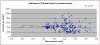
A quick grab of the data points from the scatter graph, reasonably accurate, as I get a similar r.
But if I force the trendline positive, and set intercept at zero, my r value leaps to 0.4.

Just saying.chol.png
 
Last edited:
Back
Top