• Guest - w'd love to know what you think about the forum! Take the 2025 Survey »

Ketosis questions

Chook

Expert
Messages
5,095
Location
Yorkshire
Type of diabetes
Type 2
Treatment type
Tablets (oral)
Dislikes
People who think they know everything.
I have been in ketosis (according to Ketostix) for the last couple of weeks and today tested as matching the second from right colour box which says 8 mmol/L

I have been wondering about various things:

- Is ketosis an on-off switch thing where you are either in ketosis or you're not (much like being pregnant) or is it better to be deeper in ketosis or less?

- Am I right in that ketosis is when the body switches over from burning glucose as fuel to burning fat?

- Finally (sorry for all the questions) can being in ketosis cause any long term health problems?

Thanks in advance
 
I have been in ketosis (according to Ketostix) for the last couple of weeks and today tested as matching the second from right colour box which says 8 mmol/L

I have been wondering about various things:

- Is ketosis an on-off switch thing where you are either in ketosis or you're not (much like being pregnant) or is it better to be deeper in ketosis or less?

- Am I right in that ketosis is when the body switches over from burning glucose as fuel to burning fat?

- Finally (sorry for all the questions) can being in ketosis cause any long term health problems?

Thanks in advance
-Is an on-off switch? Sort of. Either you get most of your energy from glucose (glycolysis) or from ketones (ketosis). It's a 49%-51% or 51%-49% situation. It has to be one of the other.

-Is it better to be deeper in ketosis or less? It's better to say within the healthy range. DKA (Diabetic Ketoacidosis) is a form of ketosis. However, it's characterized by SIGNIFICANTLY higher concentrations of ketone bodies than intentional dietary-induced ketoacidosis.

-Ketosis is technically defined as the point when your body gets more than 50% of its energy from ketone bodies. Your body will still get some energy from glucose no matter what, but generally very little.

-Can ketosis cause any long-term health problems? Technically, it can kill you, but again that goes back to the concentration of ketones (which are acidic) in your blood. EDIT- Didn't mean for that to scare you, but "ketosis" is a very broad term. With that said, intentional ketogenic diets have been around for about 100 years and were first used to help people with epilepsy.
 
I second everything that torq has said.
The medical profession would rather if they had the option for you to hover in and out of ketosis. The real concern for doctors is if you have enough glucose and carbs to satisfy your brain function. Which isn't too many!
Severe ketoacidosis is what most doctors are concerned about.
But if you are just in ketosis, there is no need to worry!
If you are relatively healthy, and you can fast then intermittent fasting is the latest fad within medical thinking, as this is good for your glucose, glucagon and insulin levels. Fasting gives you a period in which your body responds to being in ketosis. It also burns visceral fat just doing every day things. And when exercising.
Sleep is another period of adjustment for your body because the natural rejuvenating actions through your sleep. But it has to be a deep long sleep. Disruptive sleep is counter productive in that process.
 
Hi @Chook

There is a huge difference between ketoacidosis, experienced by T1s, and ketosis (aka nutritional ketosis) experienced by T2s on a low carb diet. There is also starvation ketosis (don't know if that term is used by anyone other than me ;) )

Ketoacidosis is the one that T1s get warned about. It is very, very dangerous, and it happens in specific circumstances - basically when insulin is very low and glucose is too high). As i understand it - I'm not T1, so I cannot speak from experience - it leads to feeling like death, hospitalisation, rehydration, medication (insulin and anything else needed), and release when stabilised. If left untreated, it can kill. If there are any T1s who want to correct me, please do!

Starvation ketosis is when people dont eat (dieting, starvation, anorexia, etc) and the body runs out of glycogen reserves and starts breaking down fat and sometimes protein, to fuel itself. It happens to anyone who doesn't eat enough to fuel their body from the food. As the reserves are broken down, they release ketones. The ketones are used as fuel. People report 'fasting highs' and 'dieting highs' feelings of euphoria when they fast. I've been there. It was a good feeling, but i didn't have huge amounts of stamina. Since the body is not T1, it has enough insulin so that ketoacidosis doesn't develop.

Nutritional ketosis (I think the term may have been coined by Voleck and/or Phinney to distinguish it from the other 2 types mentioned above) is where carbs are reduced in the diet, glycogen (glucose) reserves in the liver and muscles are used up, and the body switches over to running on ketones released from the digestion of low carb foods, and bodily fat. Depending on how much is eaten, it can become starvation ketosis, or the ketones can be provided by a lchf diet. It all depends on what and how much is eaten. Again, it doesn't develop into ketoacidosis because the body produces enough insulin to prevent it.

Here is an image to describe the ketone ranges.
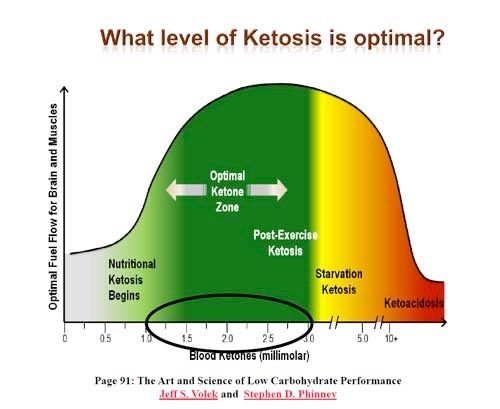
@Chook your sig says T2, but you are at the top of the range for starvation ketosis, assuming the test is accurate, (those Ketostix are nowhere near as accurate as breath or blood tests for ketones). But may i suggest you keep an eye on it? And drink plenty of water, since that helps to flush away any toxic byproducts.

You also asked if it is an on/off switch.
@Spiker used to describe it as a dial, where the body moves from one fuel to another. My experience backs this up. Although i would add that it feels (for me) as if my body gets better and better at ketosis the more i am in ketosis. It is increasingly easy to run on ketones, and to switch back and forth. Think of it like this; i used to run on petrol, then i became dual fuel, but now i am mainly electric, and petrol (glucose) just makes me stutter and backfire... ;)

As for whether it is good, long term... The studies aren't there. Yet. Opponents of low carbing always bring this up. But the evidence is growing (check out anything by Voleck and Phinney, they have been working, studying, publishing on LC, ketosis and endurance athletes for more than 20 years. It is an impressive body of work). Personally, i feel a lot worse running on glucose than on fat (ketosis), and i have been dipping in and out for 30 years now. So I will stick my neck out and say that ketosis is better for me, long term, than stuttering, backfiring and aching 24/7, which i do when burning glucose. :)
 
Thank you for your replies @Brunneria @nosher8355 and @TorqPenderloin

For the last month or so I have been in ketosis but only about 1.5 then today it was much higher. I don't test for ketones every day but today I've had a nagging headache that wouldn't go away and my BG was okay at 4.7 to 4.9 so I was trying everything. After reading your post I've just had a pint of water and 25g of Green & Blacks 85% and am feeling a bit better.

@Brunneria - On that chart does my test result of 8 moll/L put me right in middle between starvation ketosis and ketoacidosis? (I'm a bit worried now.)

Well, the 'euphoria' doesn't quite describe how I feel when I fast or eat very low carb - I would describe it more as feeling very positive and enthusiastic which probably is why I have been having a lot of very low carb days just recently.

I think in future I will test more regularly and adjust until I'm in the optimal zone. It's a learning curve.
 
:)

Have a look at the scale along the bottom of the chart. You will see it kind of jumps between 5 and 10, so don't assume that you are as far to the right as you might think.

Hope that makes sense!

Are you drinking plenty. And i do mean plenty. I live in ketosis, and i still forget to drink enough sometimes. But i have learned to read my body's signals - the slight hint of a headache, a touch of dryness on the sides of my tongue, or a sensation of pressure around my kidneys - they all disappear if i swig a glass of water.

So it may be that you were a bit dehydrated, which concentrates the urine (a lot).
It may also be that you tested at a time of day when your ketones were temporarily elevated.
Of course, I am guessing. And I'm not medically qualified.

But i wouldn't be overly concerned at this point. Keep testing. Keep drinking more than you think you need. If your ketones rise higher, or you start to feel ill, ring up the nhs helpline thingy. But unless your bg rises significantly, it won't be ketoacidosis.

I have read posts on this forum by very experienced t1s who have said that they wouldn't expect ketoacidosis without high ketones AND blood glucose in the mid-high teens. Or above.

Hope that helps.
 
@Brunneria. Yes, thanks that helps a lot. :) I've drunk so much water that my kidneys are floating and BG has dropped to 4.1 but at least the headache has stopped. If BG drops lower I'll be forced in to breaking out the 85% chocolate again. ;)
 
But Chook, Ketostix just aren't accurate enough. 8, if it was really 8, is quite high actually. Can you not lay your hands on a ketone blood meter, at the surgery say, just to check? You should, as B. says, be fine so long as your BG is low - you *can't* get into problems while it is - but still, 8 if it is really that is a bit extreme. Maybe be a bit gentler on yourself?
 
I think it was just a blip. I've tested daily since that high test and its been much lower. I'm thinking it was a) not having had enough fluids that day and b) having skipped both breakfast and lunch.

When I do a planned fast I always measure my fluids to ensure I get about three litres, minimum. But that day it wasn't a planned fast day - I just didn't feel hungry.

I have learned a lesson though - fasting is okay but it's essential to increase fluids while doing it.
 
Hi @Chook

There is a huge difference between ketoacidosis, experienced by T1s, and ketosis (aka nutritional ketosis) experienced by T2s on a low carb diet. There is also starvation ketosis (don't know if that term is used by anyone other than me ;) )

Ketoacidosis is the one that T1s get warned about. It is very, very dangerous, and it happens in specific circumstances - basically when insulin is very low and glucose is too high). As i understand it - I'm not T1, so I cannot speak from experience - it leads to feeling like death, hospitalisation, rehydration, medication (insulin and anything else needed), and release when stabilised. If left untreated, it can kill. If there are any T1s who want to correct me, please do!

Starvation ketosis is when people dont eat (dieting, starvation, anorexia, etc) and the body runs out of glycogen reserves and starts breaking down fat and sometimes protein, to fuel itself. It happens to anyone who doesn't eat enough to fuel their body from the food. As the reserves are broken down, they release ketones. The ketones are used as fuel. People report 'fasting highs' and 'dieting highs' feelings of euphoria when they fast. I've been there. It was a good feeling, but i didn't have huge amounts of stamina. Since the body is not T1, it has enough insulin so that ketoacidosis doesn't develop.

Nutritional ketosis (I think the term may have been coined by Voleck and/or Phinney to distinguish it from the other 2 types mentioned above) is where carbs are reduced in the diet, glycogen (glucose) reserves in the liver and muscles are used up, and the body switches over to running on ketones released from the digestion of low carb foods, and bodily fat. Depending on how much is eaten, it can become starvation ketosis, or the ketones can be provided by a lchf diet. It all depends on what and how much is eaten. Again, it doesn't develop into ketoacidosis because the body produces enough insulin to prevent it.

Here is an image to describe the ketone ranges.

@Chook your sig says T2, but you are at the top of the range for starvation ketosis, assuming the test is accurate, (those Ketostix are nowhere near as accurate as breath or blood tests for ketones). But may i suggest you keep an eye on it? And drink plenty of water, since that helps to flush away any toxic byproducts.

You also asked if it is an on/off switch.
@Spiker used to describe it as a dial, where the body moves from one fuel to another. My experience backs this up. Although i would add that it feels (for me) as if my body gets better and better at ketosis the more i am in ketosis. It is increasingly easy to run on ketones, and to switch back and forth. Think of it like this; i used to run on petrol, then i became dual fuel, but now i am mainly electric, and petrol (glucose) just makes me stutter and backfire... ;)

As for whether it is good, long term... The studies aren't there. Yet. Opponents of low carbing always bring this up. But the evidence is growing (check out anything by Voleck and Phinney, they have been working, studying, publishing on LC, ketosis and endurance athletes for more than 20 years. It is an impressive body of work). Personally, i feel a lot worse running on glucose than on fat (ketosis), and i have been dipping in and out for 30 years now. So I will stick my neck out and say that ketosis is better for me, long term, than stuttering, backfiring and aching 24/7, which i do when burning glucose. :)

 
Back
Top