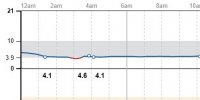
With that regular, almost repeatable low, do you cross check with your meter?I'm setting an alarm for 2:45AM on my phone to have something to eat. Just looking through the graphs nearly every night at exactly 3AM I go low. So I'm going to eat at 2:45
Not a libre user, but pretty sure that the grey band (between 4 and 10) is because T1 insulin users are encouraged to use that as the default range.
Libre is renowned for reading low at night if you are lying on it. If you are going to set your alarm, I suggest that you do a glucometer check as well.
Are you still using lantus and if so when are you injecting it?
With that regular, almost repeatable low, do you cross check with your meter?
The Libre is a marvellous thing, but it has me being extremely vulnerable Low-2.2 almost every night. Hey ho.
I don't want dosage advice (I haven't even given my dose amount for that reason), but have you heard of any stories of people being on bolus only, without lantus? My dose is so low I'm starting to suspect I don't even need it at this point in time, just the novorapid. Yet another question to ask my DNAre you still using lantus and if so when are you injecting it?
It can if it's low enough. I have no memory of my most extreme ambulance inducing hypos, though they traumatised my poor husband. Night hypos also tend to give me very dramatic dreams.Can low BSL cause memory loss?
Not something I have personal experience of (childhood T1s tend to stop producing insulin fairly fast and I was diagnosed before basal/bolus regimes were used) but logically if you are producing some of your own insulin it wouldn't at all surprise me. I have heard that some T1s have insulin free periods during their insulin honeymoons.I don't want dosage advice (I haven't even given my dose amount for that reason), but have you heard of any stories of people being on bolus only, without lantus? My dose is so low I'm starting to suspect I don't even need it at this point in time, just the novorapid. Yet another question to ask my DN![]()
Thanks!Just to answer the original question, this article explains the adoption of the 10 - 3.9 mmol/L band as desirable limits to assess 'Time in Range' targets.
![]()
Time in range: A best practice guide for UK diabetes healthcare professionals in the context of the COVID-19 global pandemic - PubMed
The emergence of continuous glucose monitoring has driven improvements in glycaemic control and quality of life for people with diabetes. Recent changes in access to continuous glucose monitoring systems within UK health services have increased the number of people able to benefit from these...pubmed.ncbi.nlm.nih.gov
Edit: these are internationally agreed ranges
Oh, I think she probably is. I had a phone appointment today and am now on the lowest lantus dose possible. The only thing I'm worried about (sort of) is how my BSL will react to snacks. I had to turn my libre alarm off last night because it was going off every hour. I can probably have a a close look at the graph and tweak the threshold but it was going 0.5 mmol over and 0.5 mmol under (roughly) every hour so the alarm would go off and wake me up. So in the end I just got out of bed. It's probably lucky I work from home and as long as my targets are met nobody cares what hours I actually do the work in because I'm doing most of my work in the middle of the night because the alarms have disrupted my sleep patternsI think you need to talk to your DN. They must be nearly as sick of your hypos as you are. Good luck.
From the paper: "Overall, the target that people with type 1 or type 2 diabetes should aim for is TIR >70% (16 h 48 min/day)."Just to answer the original question, this article explains the adoption of the 10 - 3.9 mmol/L band as desirable limits to assess 'Time in Range' targets.
![]()
Time in range: A best practice guide for UK diabetes healthcare professionals in the context of the COVID-19 global pandemic - PubMed
The emergence of continuous glucose monitoring has driven improvements in glycaemic control and quality of life for people with diabetes. Recent changes in access to continuous glucose monitoring systems within UK health services have increased the number of people able to benefit from these...pubmed.ncbi.nlm.nih.gov
Edit: these are internationally agreed ranges