
HbA1c is a term commonly used in relation to diabetes. This guide explains what HbA1c is, how it differs from blood glucose levels and how it’s used for diagnosing diabetes
What is HbA1c?
The term HbA1c refers to glycated haemoglobin. It develops when haemoglobin, a protein within red blood cells that carries oxygen throughout your body, joins with glucose in the blood, becoming ‘glycated’.
By measuring glycated haemoglobin (HbA1c), clinicians are able to get an overall picture of what our average blood sugar levels have been over a period of weeks/months.
For people with diabetes this is important as the higher the HbA1c, the greater the risk of developing diabetes-related complications.
HbA1c is also referred to as haemoglobin A1c or simply A1c
How does haemoglobin A1c return an accurate average measurement of average blood glucose?
When the body processes sugar, glucose in the bloodstream naturally attaches to haemoglobin.
The amount of glucose that combines with this protein is directly proportional to the total amount of sugar that is in your system at that time.
Because red blood cells in the human body survive for 8-12 weeks before renewal, measuring glycated haemoglobin (or HbA1c) can be used to reflect average blood glucose levels over that duration, providing a useful longer-term gauge of blood glucose control.
If your blood sugar levels have been high in recent weeks, your HbA1c will also be greater.
HbA1c targets
The HbA1c target for people with diabetes to aim for is:
- 48 mmol/mol (6.5%)
Note that this is a general target and people with diabetes should be given an individual target to aim towards by their health team.
An individual HbA1c should take into account your ability to achieve the target based on your day to day life and whether you are at risk of having regular or severe hypos.
HbA1c in diagnosis
HbA1c can indicate people with prediabetes or diabetes as follows:
| HbA1c | mmol/mol | % |
|---|---|---|
| Normal | Below 42 mmol/mol | Below 6.0% |
| Prediabetes | 42 to 47 mmol/mol | 6.0% to 6.4% |
| Diabetes | 48 mmol/mol or over | 6.5% or over |
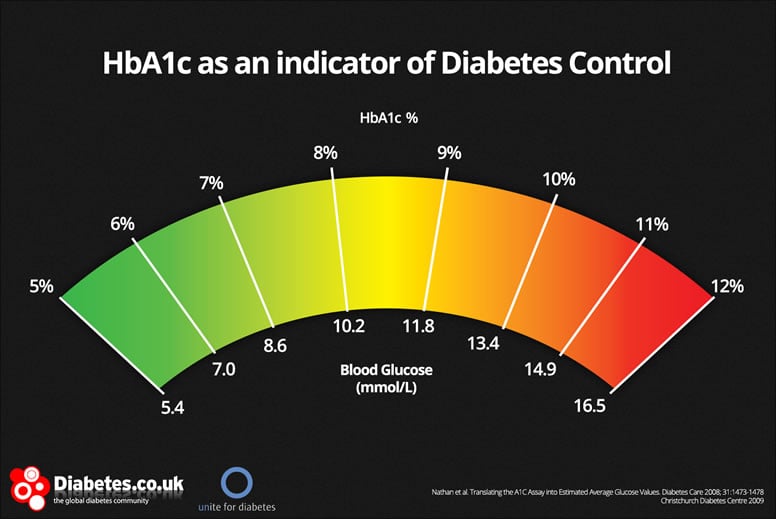
What are the benefits of lowering your haemoglobin A1c?
Two large-scale studies – the UK Prospective Diabetes Study (UKPDS) and the Diabetes Control and Complications Trial (DCCT) – demonstrated that improving HbA1c by 1% (or 11 mmol/mol) for people with type 1 diabetes or type 2 diabetes cuts the risk of microvascular complications by 25%.
Microvascular complications include:
Research has also shown that people with type 2 diabetes who reduce their HbA1c level by 1% are: [1]
- 19% less likely to suffer cataracts
- 16% less likely to suffer heart failure
- 43% less likely to suffer amputation or death due to peripheral vascular disease
How does HbA1c differ from a blood glucose level?
HbA1c provides a longer-term trend, similar to an average, of how high your blood sugar levels have been over a period of time.
An HbA1c reading can be taken from blood from a finger but is often taken from a blood sample that is taken from your arm.
Blood glucose level is the concentration of glucose in your blood at a single point in time, i.e. the very moment of the test.
This is measured using a fasting plasma glucose test, which can be carried out using blood taken from a finger or can be taken from a blood sample from the arm.
However, fasting glucose tests provide an indication of your current glucose levels only, whereas the HbA1c test serves as an overall marker of what your average levels are over a period of 2-3 months.
HbA1c can be expressed as a percentage (DCCT unit) or as a value in mmol/mol (IFCC unit). Since 2009, mmol/mol has been the default unit to use in the UK.
Note that the HbA1c value, which is measured in mmol/mol, should not be confused with a blood glucose level which is measured in mmol/l. Use our HbA1c conversion tool to help with switching between the two measurement units.
When should HbA1c levels be tested?
Everyone with diabetes mellitus in the UK should be offered an HbA1c test at least once a year.
Some people may have an HbA1c test more often. This may be more likely if you have recently had your medication changed or your health team are otherwise wishing to monitor your diabetes control more than once a year.
| HbA1c (%) | HbA1c (mmol/mol) | Ave. Blood Glucose (mmol/L) |
|---|---|---|
| 13 | 119 | 18 mmol/L |
| 12 | 108 | 17 mmol/L |
| 11 | 97 | 15 mmol/L |
| 10 | 86 | 13 mmol/L |
| 9 | 75 | 12 mmol/L |
| 8 | 64 | 10 mmol/L |
| 7 | 53 | 8 mmol/L |
| 6 | 42 | 7 mmol/L |
| 5 | 31 | 5 mmol/L |
Although HbA1c level alone does not predict diabetes complications, good control is known to lower the risk of complications
How do blood glucose levels compare with HbA1c readings?
The table on the right (figure 2) shows how average blood sugar levels in mmol/L would be translated into HbA1c readings , and vice versa.
It is important to note that because blood glucose levels fluctuate constantly, literally on a minute by minute basis, regular blood glucose testing is required to understand how your levels are changing through the day and learning how different meals affect your glucose levels.
Share your readings over on the forum
Interacting with other members of the diabetes community is a great way to broaden your understanding the technicalities of things like haemoglobin A1c levels and how to manage them. Head over to the HbA1c forum to let everyone know how you’re getting on.
Read more about HbA1c:
Can I test my own HbA1c at home?
While you should receive an HbA1c test every 3-6 months from your GP, you can also buy at-home HbA1c tests which require you to prick your finger and collect a sample of blood, as well as HbA1c meters similar to a traditional finger-prick blood glucose meter.


