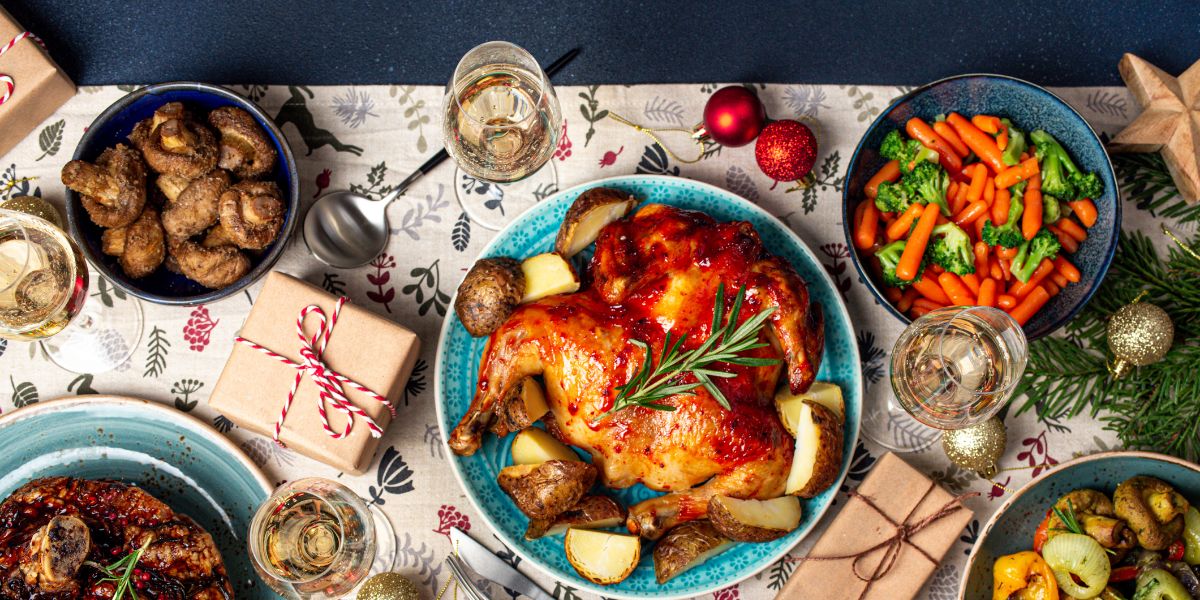

It is easy to feel like Christmas automatically equals weight gain.
You eat differently, you move less, you sleep at odd times and there is food everywhere.
The scale often jumps and it can feel like you have undone months of effort in a week.
Here is the reality: most people do not gain anything dramatic over a few festive days.
When the scale goes up quickly it is usually water, stored carbohydrate and plain old food still sitting in your gut.
Fat gain needs a sustained calorie surplus over time.
A short burst of rich meals can nudge weight up but it rarely turns into a huge permanent change unless the “Christmas period” quietly becomes January and February too.
Why the scale spikes so fast
A big festive meal often means more carbohydrates than usual, more salt than usual and later nights.
Carbohydrate is stored as glycogen in your liver and muscles and glycogen pulls water in with it. Salt also encourages water retention.
Add in alcohol, less sleep and constipation for some people and you can easily see a couple of pounds appear almost overnight without it being body fat.
When normal routines come back the water drops, glycogen levels settle and your digestion gets back to normal.
- Weight Loss: How to Lose Weight and Keep It Off
- Boosting GLP-1: how to increase GLP-1 levels naturally
That is why many people notice their weight drifting back down without doing anything extreme.
What studies have found
There are not loads of high quality studies tracking real world weight change over Christmas but the ones that exist suggest the average change is small.
One American study that followed adults across the winter holiday period of roughly six to eight weeks found an average gain of about 0.37 kg.
A Swedish study reported around 0.4 kg in non obese adults over a two to three week Christmas break.
A larger UK study published in 2020 that tracked people from late November to the end of January found an average increase of about 1.35 percent, around 1.2 kg for a typical adult, with weight starting to fall again later in the spring.
The big takeaway is variation.
Some people gain very little, some gain more and a minority can swing a lot in either direction.
If you already live with obesity the range can be much wider.
The calorie myth and why people respond differently
You may have heard that 3,500 extra calories equals one pound of weight gain. It is not that neat in real life.
People differ in body size, muscle mass, hormones, age and daily movement.
Two people can eat the same extra amount over Christmas and see very different results on the scale.
Men often gain less easily than women because they tend to have more lean mass and a higher resting energy use.
Genetics matter.
Some health conditions can matter too, including an underactive thyroid.
Medication can also affect appetite, fluid balance or both.
Does short term weight gain affect health
Even small weight gain over a few weeks can cause measurable changes in the body in research settings, especially if the diet is much richer than normal.
That said, the bigger issue for most people is not what happens between Christmas Eve and Boxing Day.
It is what happens afterwards.
If you go back to your usual habits the festive bump is often temporary.
If Christmas turns into a six week drift of bigger portions, more snacking and less movement then that is when small gains can become the new normal.
A practical approach that actually works
The worst thing you can do is panic, feel guilty and try to “fix” it with a hard reset in January.
Crash dieting tends to backfire. It can increase hunger, worsen cravings and set up a cycle of restriction then rebound eating.
What does work is boring but effective. A few small guardrails that are easy to stick to.
A brief intervention tested in the UK showed that simple steps helped.
People who got basic guidance, weighed themselves regularly and were shown the activity needed to burn off common treats avoided the small gains seen in those who carried on as normal.
No detox, no punishment, just awareness and a bit of structure.
Focus on glucose not guilt
If you live with diabetes, the main risk over Christmas is not a couple of pounds – it is glucose variability.
Big festive meals, alcohol, skipped routines and less activity can push blood glucose up and down more than usual.


